[ Excerpt from The Science of Yoga, page 466 ]
You have already been introduced to a term yoga mudra near the beginning of this course, referring to the 'gesture of union' whereby the hands/fingers are interlocked with the fingers of the right hand dominant. This is a very preliminary yet important introverted gesture that helps to control the senses (karmendriyas) and their tendency to turn outward.
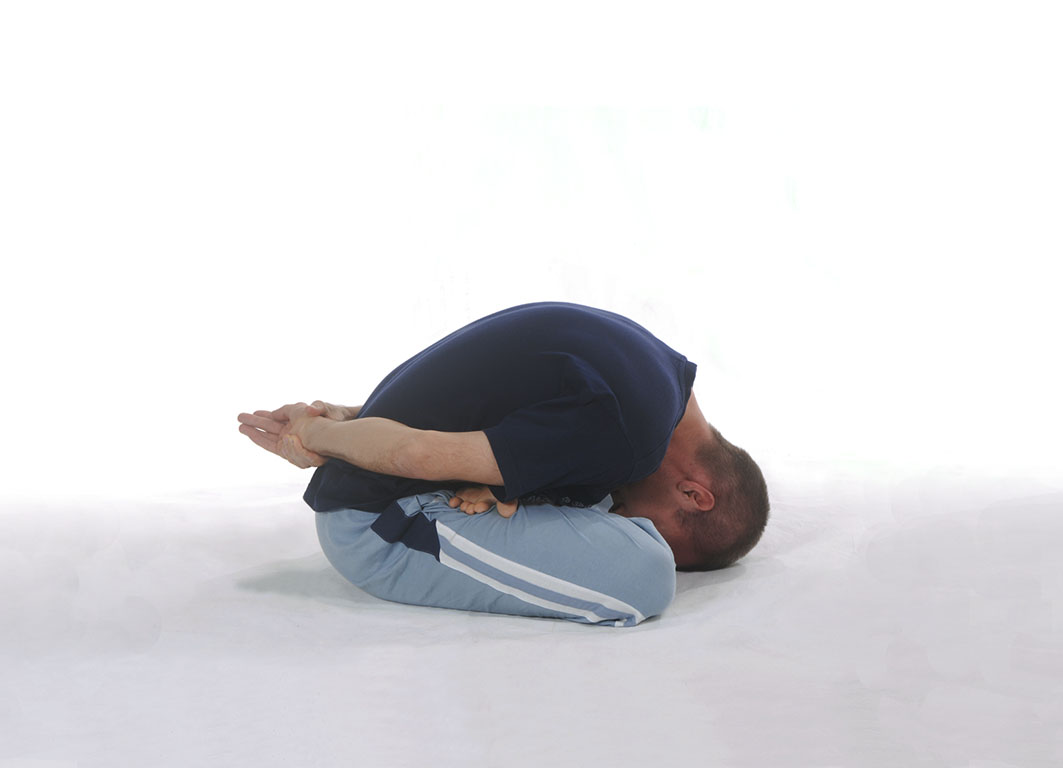
The term yoga mudra also refers to an advanced position attained from the padma asana, which I refer to here as yoga mudra asana for distinction.
Technique
- In the padma asana, reach behind with both arms and grasp your right wrist with your left hand.
- On an exhalation, the forehead is slowly lowered to the floor in front.
Note: try to place the centre point between the brows in contact with the floor.
- Hold this position and breathe in a calm and shallow fashion (sukshma pranayama).
- Inhale and slowly return to the padma asana.
- Caution
Only attempt the practice of yoga mudra asana once you have become able to sit comfortably in padma asana. Again, this posture demands a great deal of flexibility and stability in the joints of the hips, knees and ankles. Only move as far into the position and hold it for as long as you are comfortably able. Gradually try to work up to being able to hold this position for 2 to 3 minutes.
Effects and Benefits
This mudra is the perfect symbol of yoga, or union. It is a position of passivity and rest which harmonizes the psychic energy flows. You will also find this to be a very powerful practice for internalizing the consciousness.
In this position, the spine is stretched wonderfully, providing a great release of tension particularly in the lumbar and cervical areas, while at the same time providing a toning effect upon the spinal nerves.
The intra-abdominal pressure gives a great massage to the abdominal organs and helps stimulate peristalsis, while the position of the hands locked behind the back helps to open up the chest and expand the breathing capacity.
As well, there is a great calming effect to the mind in this position, providing relief of mental stress and tension.
[Continued...]
DISCLAIMER:
The contents of this web page are intended for informational purposes only. One should not engage in any yoga practices based solely upon the directions given on this web page or any other page of this web site. Anyone atempting to perform any of the yoga exercises introduced on this website assumes full responsibility and does so at their own risk.
---------------------
NOTE: This yoga article is an excerpt from The Science of Yoga, an online yoga training program with streaming yoga videos and 600 pages of step-by-step yoga instruction.
"The Science of Yoga is a course worthy of
leather binding and an honored place in the
finest libraries in the world
... It is indeed a masterful work."
Dr. John Michael Christian
AwakeningWithYoga.com
Learn More About
The Science of Yoga Course
|