[ Excerpt from The Science of Yoga, page 150 ]
The ashtanga yoga system of Sage Patanjali is a comprehensive system for the attainment of ultimate spiritual unity, tried and proven by countless masters over the ages. This system can loosely be seen to encompass three schools of yoga: kriya yoga, hatha yoga, and raja yoga.
Kriya Yoga
This is the "yoga of extreme purification." Most commonly, kriya yoga is taught as a system of practices for bodily cleansing and purification. Purification in kriya yoga happens on many levels of the being, including the energetic (pranic) as well as the mental and higher psychic dimensions. The common bodily purification techniques known as kriyas, which includes practices for purifying the nadis and energetic system, actually fall within the discipline of hatha yoga.
When we speak specifically of the field of kriya yoga, we refer to a process of purification at the higher level of the mind. This relates, within the ashtanga yoga system of Patanjali, to the first two of the eight limbs -- namely yama and niyama (which we will begin to explore soon). Patanjali himself refers to kriya yoga as the final three niyamas:
"TAPAH–SVADHYAYESVARA–PRANIDHANANI KRIYA–YOGAH"
~ Sadhana Pada, Verse 1
Translation: Austerity, Self-study and dedication to the Highest constitute the preliminary kriya yoga.
Thus, kriya yoga, as it pertains to the re-organization of one's attitudes and beliefs, and the purification of the mental plane, is the preliminary step toward yoga. As surely as one cannot successfully "build a house upon shifting sands," one cannot build the structure of a higher spiritual life without the solid foundation of yama-niyama.
Hatha Yoga
This is the most popular 'yoga' in the West, which in its essence is based on the balancing of the fundamental polarities of the being, the solar (+) and lunar (-) energies. Its aim is the recovery and maintenance of perfect health, the development of the mind and its mastery over the body, and perfect control over the vital energies.
With respect to the ashtanga yoga system of Patanjali, hatha yoga can be loosely seen to encompass the third and fourth of the bahiranga, or outer disciplines; namely asana and pranayama.
In a broader sense, though, hatha yoga is a complete system of bodily health which encompasses the physical cleansing kriyas such as the shat karmas, diet and hygiene, and the physical yoga techniques of asana, pranayama, bandha and mudra. All of these are essential preparation for the higher (inner) stages of ashtanga yoga.
Raja Yoga
Raja means "royal" or "highest," which is why raja yoga is referred to as the "highest yoga" or the "yoga of Supreme Realization."
Raja yoga aims at fusion with the macrocosmic, Universal Mind—in practice seeking the amplification of the power of the mind, mental control, and the arousing of the Third Eye (ajna chakra).
Raja yoga then, can be referred to as the "yoga of the mind" or the "yoga of transcendence of the body by the mind."
Patanjali's classical ashtanga yoga in its entirety is often referred to as raja yoga, in that it is a complete system for the evolution of the consciousness to the highest state of Self-realization.
More specifically, raja yoga represents the inner aspects (or antaranga) of this 8 stage system -- or the three final stages of dharana (concentration), dhyana (meditation), and samadhi (mergence with the Divine).
"There can be no raja yoga without hatha yoga and no hatha yoga without raja yoga. Hatha yoga is the preparation for raja yoga and raja yoga is the goal of hatha yoga."
~Hatha Yoga Pradipika
[Continued...]
---------------------
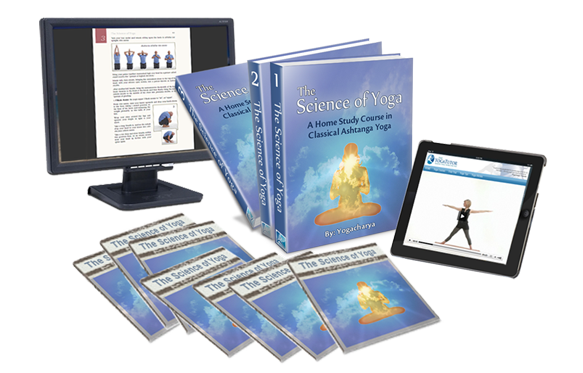
NOTE: This yoga article is an excerpt from The Science of Yoga, an online yoga training program with streaming yoga videos and 600 pages of step-by-step yoga instruction.
"The Science of Yoga is a course worthy of
leather binding and an honored place in the
finest libraries in the world
... It is indeed a masterful work."
Dr. John Michael Christian
AwakeningWithYoga.com
Learn More About
The Science of Yoga Course
|